
Status: Confirmed from official embassy pages
Assessment: Precautionary, region-wide, not a confirmation of current airspace closures
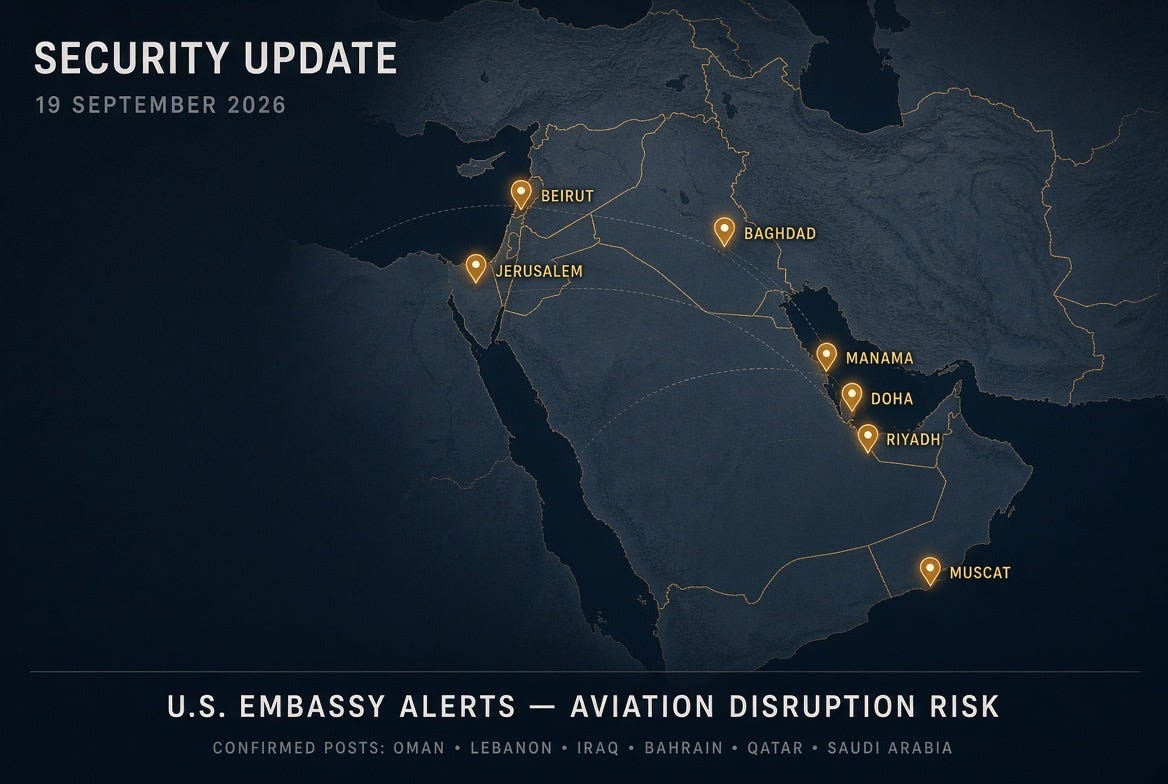
U.S. diplomatic missions issued a near-identical security alert this evening warning of possible flight cancellations, airspace closures, and travel disruptions across the Middle East. The wording is coordinated, not country-specific improvisation.
Confirmed official posts, 19 September 2026
• U.S. Embassy Muscat (Oman)
• U.S. Embassy Beirut (Lebanon)
• U.S. Mission Iraq (Baghdad; also lists Erbil, Basrah, Sulaymaniyah)
• U.S. Embassy Manama (Bahrain)
• U.S. Embassy Doha (Qatar)
• U.S. Mission Saudi Arabia
Media also reported a matching Jerusalem alert tonight. The embassy website archive still showed 1 September as the latest tagged notice at the time of review, so treat Jerusalem as reported pending the public page. om.usembassy.gov
What the alerts say
The security environment remains complex, with room for sudden escalation. Travelers should expect possible last-minute schedule changes. The notices also cite Houthi attacks on Saudi targets, including civilian airports, and warn that Iran and aligned groups may strike U.S. diplomatic sites and other U.S.-linked locations, including outside the region. lb.usembassy.gov
What this means
This is a consular readiness message, not an announcement that airspace is closed. Similar language went out in July and on 1–2 September during earlier spikes. Tonight’s batch is a fresh, multi-post refresh after reported Houthi activity against Saudi Arabia. Parallel embassy notices usually precede NOTAMs, reroutes, or short-notice airline changes rather than proving an attack is already underway. newsweek.com
Watch next
• Airline and airport status at Muscat, Beirut, Baghdad/Erbil, Bahrain, Doha, Riyadh/Jeddah, and Ben Gurion
• New or updated NOTAMs over the Gulf, Levant, and Red Sea
• Whether Jerusalem, Amman, Abu Dhabi, Kuwait, and other posts publish the same template
• Any local siren, shelter, or air-defense activity that would move this from travel risk to immediate threat
Travelers in or transiting the region should confirm flights directly with carriers, keep documents and comms ready, and follow local authority guidance.