
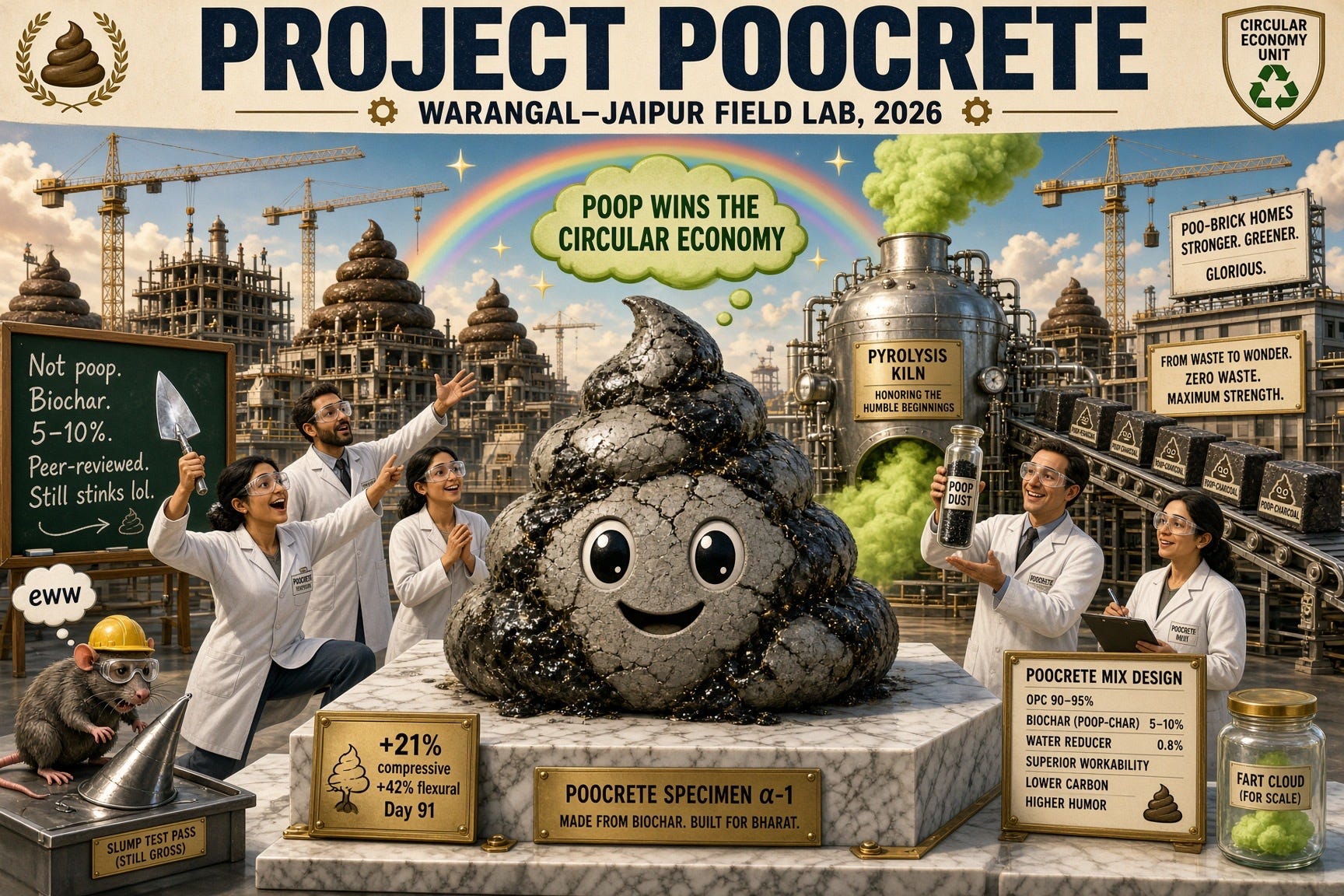
Well, I saw a story on this and thought it needed to be validated. It’s accurate. It’s happening. Poocrete is real. Maybe they can start with Congress. They’re definitely full of shit.
India’s “poocrete” is not a joke mix. It is treated human waste, turned into biochar, and used to replace a slice of cement. In lab tests from Manipal University Jaipur, the resulting concrete came out stronger than the ordinary mix it was measured against.
Civil engineer Raghuvesh Tiwari and colleagues, working with researchers at Louisiana Tech, took fecal sludge from a treatment plant in Warangal, Telangana. The sludge was dried, heated in a low-oxygen environment at 350–450°C, then ground and sieved into a fine black powder. That powder replaced 5%, 10%, and 15% of ordinary Portland cement in otherwise conventional concrete. The samples were tested for compressive strength, flexural strength, water absorption, porosity, and shrinkage after 28, 56, and 91 days of curing.
The 10% mix produced the numbers that travelled. After 91 days it showed about a 21% increase in compressive strength and a 42% increase in flexural strength versus the control. The 5% mix also beat ordinary concrete, with roughly 20% higher compressive strength and 36% higher flexural strength. At 15%, performance fell. Durability results at the lower doses were competitive or better: less water uptake and porosity in some tests, and shrinkage comparable to ordinary mortar after 120 days. The researchers suggest the porous char acts as a set of tiny water reservoirs that keep hydration going as the concrete ages.
That is why the work matters in India. Cement is one of the world’s largest industrial sources of carbon dioxide, and India is the second-largest cement producer. Housing, metros, highways, and PMAY-style programmes keep pouring demand into the sector. At the same time, fecal sludge remains a live sanitation problem. Treatment plants already exist. Using a processed fraction of that waste as a cement extender turns a disposal stream into a construction input and modestly cuts clinker use.
The paper is cautious. The gains showed up most clearly at later ages. The useful window looks like 5–10% replacement, not “the more waste the better.” This is still laboratory work. Field batches, variable sludge chemistry, codes, long-term exposure, and public acceptance have not been settled. Heavy-metal leaching was reported as reduced with higher biochar content, which is encouraging and not a substitute for full environmental review. Scale would also require consistent, quality-controlled biochar from many plants, not one research lot.
The nickname is catchier than the method. This is not raw sewage in a mixer. It is a high-temperature char from treated sludge, used at modest replacement rates. The science is early. The policy fit is tighter: India already collects the waste and already pours the concrete. If durability and supply chains hold, the first honest uses are the unglamorous ones—pavers, blocks, low-risk components—while longer data accumulate.
The circular-economy pitch writes itself. Whether contractors, regulators, and buyers will accept a material whose feedstock began in a toilet is the part the lab cannot answer.
Sources
Tiwari, R., Mehra, P., Hussain, S., and Anand, S. “Mechanical, durability, and microstructural performance of biochar-modified concrete using faecal sludge–derived biochar.” Scientific Reports, 2026.
ScienceAlert, “Scientists Are Making Concrete With Human Poop – And It Gets 42% Stronger,” 8 September 2026.
India Today, “Scientists turn human poop into concrete and it’s surprisingly 42% stronger,” 9 September 2026.
The Economic Times, “Indian scientists develop a new concrete using human waste…,” 9 September 2026.
Times of India, “Scientists turned human poop into concrete; one mixture was 42% stronger after 91 days of curing,” 10–11 September 2026.
The Cool Down, “Researchers in India say poop-based biochar made concrete over 40% stronger,” 15 September 2026.
BBC Newsround, “Could poo be used to make concrete in the future?,” 9 September 2026.
Popular Mechanics, “Scientists Have a Secret Ingredient for Better Concrete: Your Poop,” 14 September 2026.