
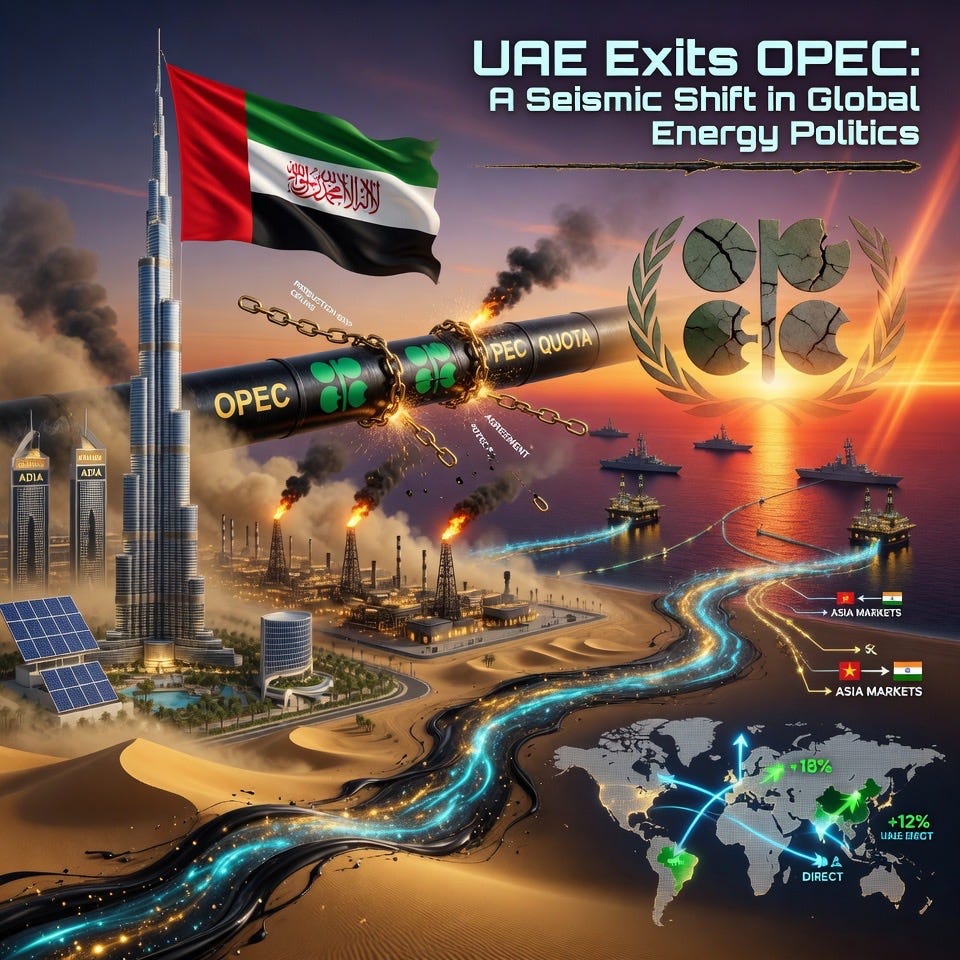
On April 28, 2026, the United Arab Emirates announced it would withdraw from the Organization of the Petroleum Exporting Countries (OPEC) and the broader OPEC+ alliance effective May 1—just days after nearly six decades of membership. The move, confirmed by UAE Energy Minister Suhail Mohamed al-Mazrouei, removes one of the cartel’s largest and most capable producers from coordinated quota systems at a moment of acute global energy stress. With the Strait of Hormuz effectively closed amid the ongoing US-Israel conflict with Iran, oil markets are already grappling with historic supply disruptions. The UAE’s departure adds another layer of complexity to an already volatile landscape.
The UAE joined OPEC in 1967 through Abu Dhabi and maintained full membership after the federation’s formation in 1971. It ranks as the cartel’s third-largest producer behind Saudi Arabia and Iraq, currently pumping around 3.4–3.5 million barrels per day (bpd) with installed capacity reaching 4.8 million bpd and plans to expand toward 5 million bpd by 2027. By stepping outside the quota framework, the UAE gains the ability to set production levels independently, guided by what officials describe as “national interests” and a “longer-term economic vision.”
Why the UAE Left: National Strategy Meets Geopolitical Strain
UAE officials frame the exit as a policy evolution rather than a sudden rupture. The country has long chafed under OPEC production caps that constrained its output despite billions invested in upstream capacity—roughly $15 billion in recent years alone. With a highly diversified economy anchored by a massive sovereign wealth fund, the UAE’s fortunes are increasingly tied to global economic growth rather than oil-price volatility alone. Leaving frees it to ramp up exports in line with demand, potentially strengthening ties with major importers such as China and India while prioritizing domestic development goals.
The timing, however, coincides with extraordinary pressures. The Iran war has triggered an unprecedented energy crisis, with the Hormuz blockade severely limiting Gulf exports and driving crude prices higher (Brent recently trading around $111 per barrel). Analysts note growing rifts between the UAE and Saudi Arabia—the de facto leader of OPEC—exacerbated by differing approaches to the regional conflict and production policy. The UAE has criticized Gulf partners for insufficient action against Iranian threats, and its diversified economy positions it to weather potential price wars better than some peers. As one expert summarized, the UAE’s spare capacity (1–1.5 million bpd) represented critical flexibility for the cartel; its departure signals that national priorities have diverged from collective OPEC+ discipline.
Implications for OPEC and OPEC+
The exit delivers a tangible blow to OPEC’s cohesion and market influence. OPEC now operates with 11 members (down from 12), and the wider OPEC+ alliance—including Russia and other non-OPEC producers—loses control over a meaningful slice of global supply. Collectively, OPEC+ accounts for roughly 41 percent of world oil production; the UAE’s removal reduces the group’s share of the roughly 102 million bpd global market and erodes its ability to enforce output adjustments.
OPEC+ sources insist the alliance will remain intact and continue coordinating policy, with Saudi Arabia still able to steer decisions. Yet analysts across Reuters, the BBC, and energy consultancies warn of structural weakening: less spare capacity to offset disruptions, reduced credibility in quota enforcement, and heightened risk of internal fractures. If the UAE successfully boosts output post-Hormuz reopening, it could pressure prices downward, forcing Saudi Arabia into difficult choices—potentially triggering a price war that smaller, less diversified OPEC members (reliant on higher revenues) would struggle to endure. Long-term, the move diminishes the cartel’s historical leverage over global supplies, complicating efforts to stabilize or elevate prices during future gluts or shocks.
Effects on the World Oil Market and Beyond
Short-term impacts remain muted by the Hormuz blockade: the UAE cannot immediately flood markets with additional barrels even if it wants to. Global inventories are tight, and the broader supply crisis dominates price movements. Over the medium to longer term, however, the shift introduces new dynamics:
Supply and Prices: Greater UAE autonomy could add 1–1.5 million bpd of incremental production once logistics normalize, anchoring prices lower in a post-crisis environment. Some forecasts see Brent easing toward the high $60s range within 12 months under ample-supply scenarios, though geopolitical volatility could sustain upside risks.
Market Stability: OPEC’s reduced ability to manage output may increase price swings. The cartel’s spare-capacity tool—historically a stabilizer—loses a key contributor, potentially leading to more frequent boom-bust cycles.
Geopolitical Ripples: The departure is widely viewed as a win for oil-importing nations and consumers, eroding cartel power in favor of market-driven forces. It aligns with broader shifts away from fossil-fuel dependence in some regions while underscoring Gulf states’ strategic recalibrations. For major importers like India and China, the prospect of steadier or cheaper supply offers relief amid diversification efforts.
Energy markets, refining margins, and related sectors (aviation, shipping, petrochemicals) stand to benefit from any supply relief, while upstream investors and national budgets in quota-dependent producers face new uncertainties.
Who Is Most Impacted—and the Trade-Offs
OPEC and Saudi Arabia: The clearest losers in influence. Loss of the UAE’s production weight and institutional credibility weakens the group’s discipline mechanism. Saudi Arabia must now shoulder more of the burden for market management, potentially at higher domestic economic cost.
Smaller OPEC Members: Countries with limited diversification and heavy reliance on oil revenues could suffer most if prices soften. Reduced cartel leverage may translate into lower fiscal stability for nations already stretched by global energy transitions.
Global Consumers and Importers: Households, businesses, and economies in the US, Europe, Asia, and beyond gain from potential downward pressure on fuel and energy costs. Lower prices support inflation control, consumer spending, and industrial competitiveness—benefits that cut across ideological lines.
The UAE: Primary beneficiary. Autonomy allows it to align production with its economic roadmap, capture more revenue during high-demand periods, and deepen non-oil partnerships without quota friction. Its diversified model buffers it against price volatility better than peers.
Russia and OPEC+ Allies: Indirect pressure on the broader alliance’s effectiveness, though Russia’s own production remains outside direct OPEC quotas.
In balance, the exit reflects accelerating fragmentation in global energy governance. Supporters of freer markets see it as a healthy step toward competition and efficiency; traditional cartel defenders warn of instability and lost producer leverage. Data from the past decade shows OPEC+ has successfully influenced prices during downturns, but sustained quota adherence has grown more challenging amid shale growth, renewables, and internal rivalries.
The UAE’s departure does not dismantle OPEC overnight, nor does it instantly transform daily gasoline prices. It does, however, mark a pivotal realignment: a major Gulf producer prioritizing sovereign flexibility over collective discipline at a time when geopolitics and economics are pulling energy alliances in conflicting directions. As Hormuz tensions evolve and new production comes online, the full consequences will unfold in barrels, budgets, and balance sheets worldwide—underscoring how quickly yesterday’s energy certainties can give way to tomorrow’s recalibrations.